RIF

image
Bloedell Preserve, Bainbridge Island, WA 25.07.15

My friend lost her job yesterday after ten years at a company headquartered here in Dallas. She’s one of my favorite people – so creative, talented and smart. She got RIFFED. That’s Reduction-In-Force, so not the same as a Donald Trump-style firing. It still hurts, though.

I should know. I got “RIFFED” 24 years ago and I want to tell my friend it was the best thing to happen to me, work-wise.

There I was back in 1992, 33 years old, MBA recently in hand, living in Nevada, and had been a hospital chief operating officer (COO) for about four years. Back then, the shoulder pads on my skirted suit jacket probably helped me avoid injury as my head butted up against the glass ceiling.

As my male peers kept getting promoted to hospital CEO positions in the company, I was offered either psychiatric hospital CEO positions or COO at a larger hospital in south Texas. As it turned out, I would have been nuts to take either option.

The psych hospital gig would have been a one-way ticket out of acute care with lower pay, and the CEO at that south-Texas hospital was later charged with sexual harassment by his female COO. Nice options, huh?

Then I got engaged to a long-time Nevadan. I wasn’t planning on moving. Back at the hospital, I was doing well, my departments were profitable, and I had a good working relationship with the CEO. What I didn’t have was a good relationship with the Chief Nursing Officer (CNO).

There were rumors swirling around the hospital that CEO and CNO were having an affair. CEO’s wife didn’t live in Nevada. In his defense, I saw no proof of an affair, and CNO didn’t really get in my way because she only worked part time (in violation of state and federal acute care hospital licensing requirements).

I thought things were hunky-dory when I met with CEO one afternoon in May. He proceeded to pull the rug out from under me: my position had been eliminated. It wasn’t a hospital-wide RIF, just my position.

Say what? You mean in spite of the fact that I’d developed several profitable service lines and received written commendations? In spite of the fact that my departments were profitable? Yup. In spite of all that.

I was devastated. As I was packing my desk, one of the hospital-based physicians I’d befriended came by to tell me about a job I might be interested in right there in river city. The administrator of an ambulatory surgery center had recently died and that company was looking for a replacement. He showed me their surgery schedule for the day (this was before HIPAA), and it was on legal-size paper, covering the front and half the back. That outpatient surgery center was doing three times as many surgeries that day as the hospital from which I was about to depart.

Not having many other choices at the time, I applied for the job. After three interviews including a one-day meet-everyone-in-the-Dallas-corporate-office extravaganza, they hired me. I was impressed at the time that the company, Medical Care America (MCA), had been very sensitive and accommodating with the center staff about the death of my predecessor and demonstrated great concern for them.

As it turned out, my talents and strengths were ideally suited to the then-nascent outpatient surgery center industry. I loved my staff and managers, I loved the doctors I worked with, and I loved that our patients loved us. I really liked the autonomy of the job and the corporate culture of growing the business. I was supported and empowered and had found my niche.

And if I hadn’t been RIFFED from the hospital, I would never have applied for that job. Later that year, my old hospital corporation wised up, CEO and CNO and were canned.

My surgery center was profitable. I opened a second center in that city and found I enjoyed that process, and was asked to oversee a third center. MCA was sold to HCA. For the next twenty years, I developed and managed outpatient surgery centers for the biggest for-profit hospital companies in the U.S. I worked hard, had fun, and made friends I have still.

And if I saw CEO today, I would thank him from the bottom of my heart.

Lost at Sea!

Fergie
Fergie

Fergie was not a good dog. Adopted from an ex-girlfriend because she didn’t get along with the woman’s other dogs, Fergie never had the impression my husband had rescued her, but indeed he had.
Fergie would only consent to doing her business outside when confined to our kitchen, so she was always a kitchen dog and used the dog door. If we weren’t up by 5:30 a.m., she would made that happen with a loud, high-pitched, incessant bark emanating from her seven-pound Yorkshire terrier body.
She’d growl in protest at being picked up and petted. She’d growl at being put down. She’d growl every time my husband hugged me. And she’d start barking in anticipating as we crossed the last bridge to our cabin on Lake Tawakoni, 50 miles east of Dallas.
Fergie’s terrible temperament was acknowledged by all except my husband, Mr. Tenderheart. He loved her, and I came to respect this bundle of fur for her sheer determination.

St. Francis of Assisi

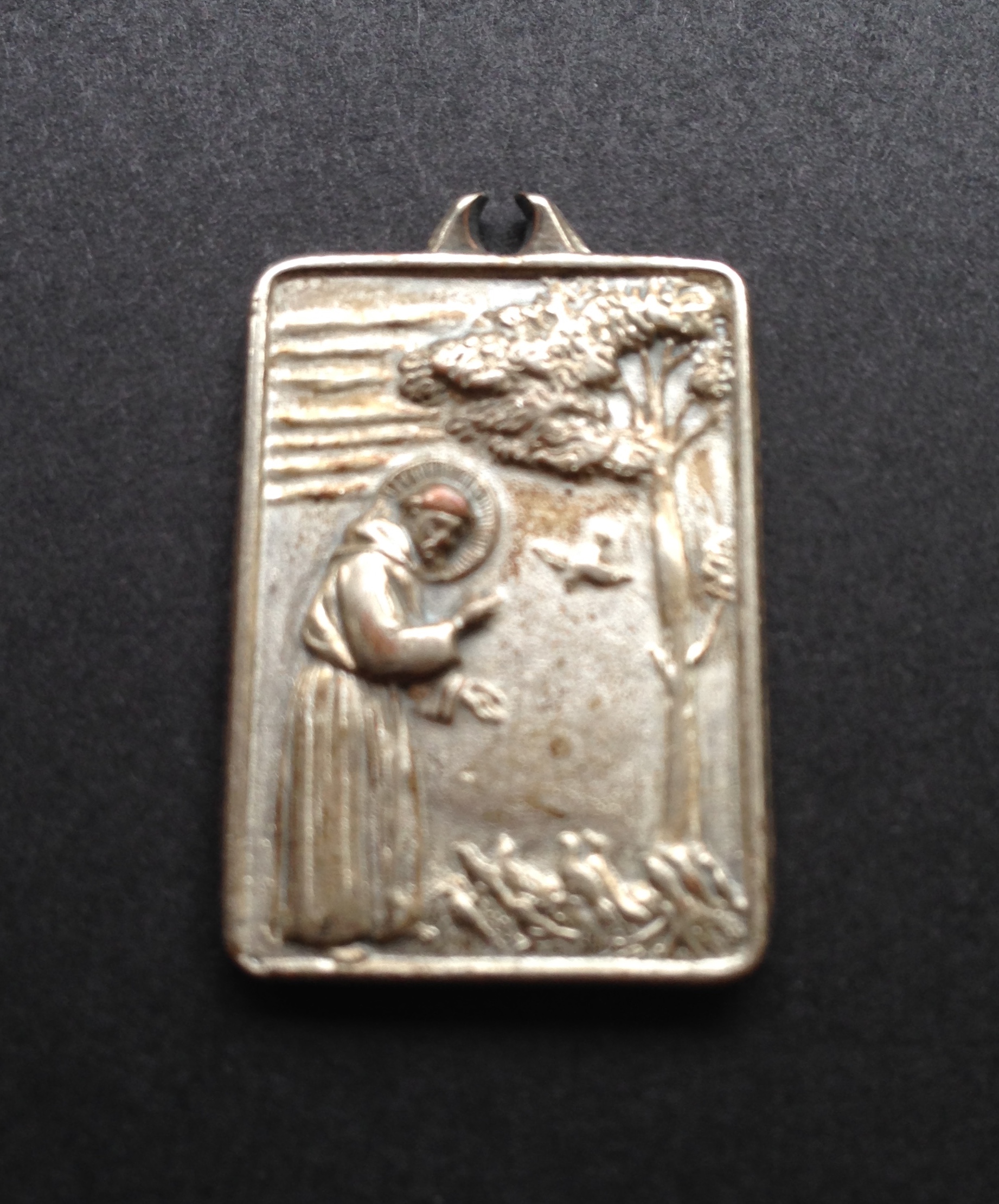
It was with significant trepidation, then, that we finally put the St. Francis medal on her collar. My friend, Patty, got it for Fergie during Patty’s trip to Italy, led by her Catholic priest. She purchased it at the Assisi Basilica, it was blessed by the priest in that magnificent church, and then reportedly blessed again by the then-Pope, now Saint John Paul II, in Rome.
We waited several days before we put St. Francis, Patron Saint of Animals, on Fergie’s collar, admittedly in fear that our devil dog would be struck by lightening, or melt. Finally, we braced ourselves and did it. Nothing happened.
Fergie loved being at the lake with our two other terriers, Jake and Elwood. They would frolic on the wide lawn and chase squirrels, while Fergie gamboled alongside, never deigning to participate in a chase.
She liked being on the boat, a small, used ski-boat we bought, and it was on that boat that tragedy struck.
We were around the peninsula in the next cove, the one we called “Millionaire’s Cove,” because one of the houses – probably the only one on the lake – was listed for sale for over $1 million. It didn’t sell in all the time we owned our cabin.
The boat was anchored in the middle of the cove and we were in the water paddling around it when we heard thunder in the distance. As usual on Lake Tawakoni, there were no other boats in sight. “Guess we better head back,” my husband said. We got back in the boat and it looked like the dogs thought we should head back as well.
The thunder grew nearer as we pulled the boat into the boat house, made sure the slings were in position, and turned on the motor to lift it out of the water.
I picked up each dog in turn and put them on the boathouse deck, saying, “Dog One, Dog Two.” I looked around for Fergie, who was always Dog Three and she wasn’t in the boat!

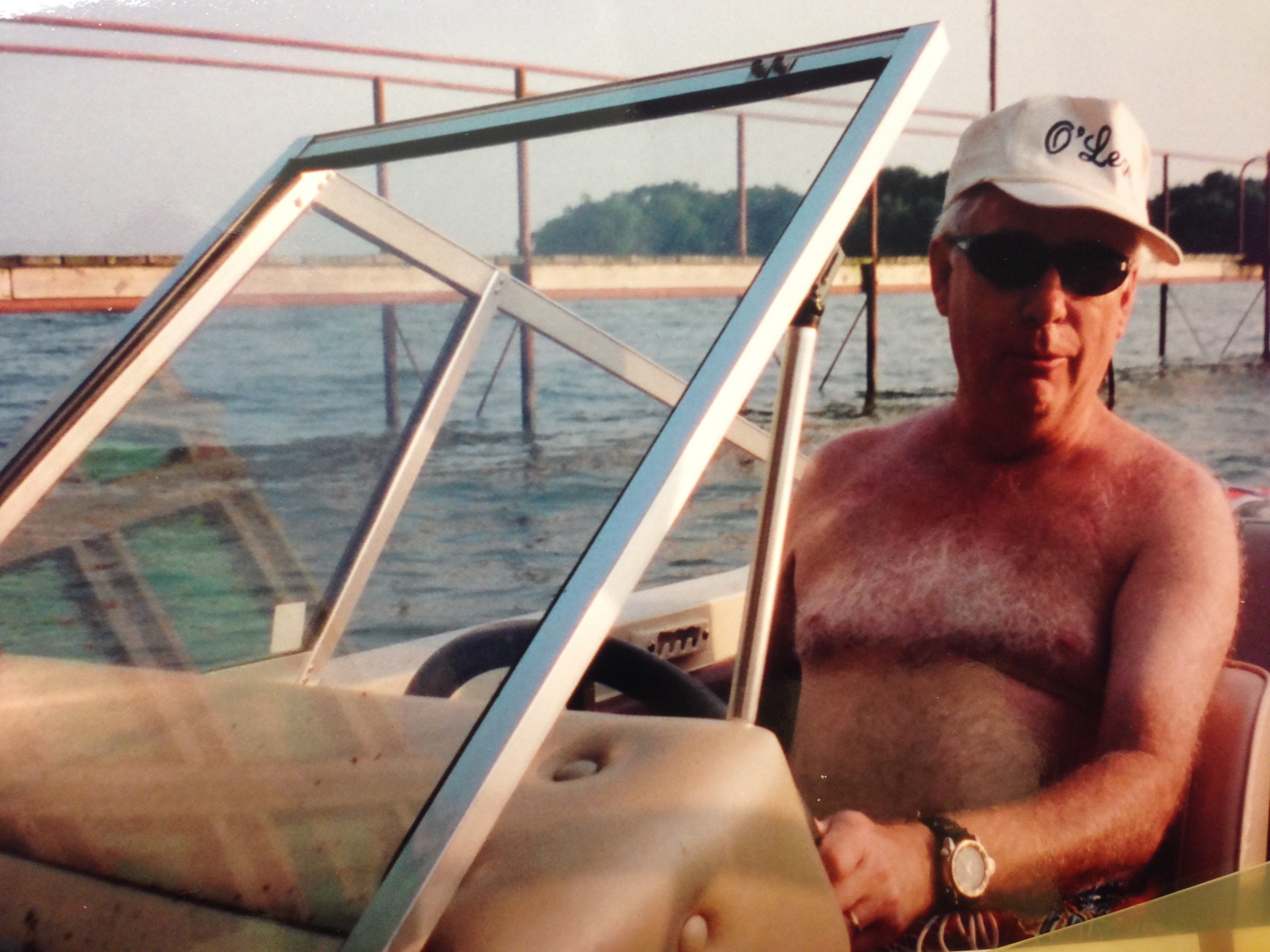
Mont in the boat
Mont in the boat

Fergie had the habit of jumping up on top of the back cushion, but I was sure she was on the floor of the boat as we headed back. Clearly that was not the case, and I blamed myself, as my husband had his hands full steering. We got back in the boat, lowered it, and buzzed back to the cove as the thunder got closer. We could see lightening strikes a few miles away.
We searched in the water and along the shore but there was no sign of The Ferg. We finally had to go back when it became clear the storm was heading straight for us. With no sign of her, we were sure Fergie had jumped up on the back, fallen off, and been pulled under in the boat’s wake.
We were both miserable, as were Jake and Elwood. I may not have loved Fergie as much as my husband (no one could), but I certainly didn’t want to be responsible for her death, and it was clear I was because I should have been watching out better.
Mont, my husband, didn’t blame me, though, and we tried to comfort each other through our tears. We asked our neighbors to be on the lookout, but the fact that we hadn’t seen or heard her in the water or on the shore made us pretty sure she was gone forever.
“Fergie’s alive!” Mont shouted over the phone four days later when I was on a business trip in Houston.
“What?”
“A woman heard Fergie barking on a dock in that cove and picked her up. I’m going to meet her tomorrow in Rockwall and bring her home.”
I was so relieved I broke down right there in my hotel room and sobbed. Thank God she was found. Thank God she had that miserable high-pitched, incessant bark that demanded attention.
Our Good Samaritan had bathed Fergie, and when I got home late the next day she seemed exactly like her old self: same bark, same growl, undiminished by her ordeal.
I heard a tinkle on the tile floor and looked down to see the St. Francis medal had just fallen from her collar. His work was done.

A Gramp Camp Adventure

Grandpa and Grandma with my brother in Oakville, circa 1954

“Don’t go into the barn,” were the only words of caution my grandparents gave my brother, three cousins and me when we set out to explore their small farm outside Oakville, Washington. So, of course, the first thing we did was head to the barn, albeit via a circuitous route.
We’d walk in the opposite direction, down the shaded lane that was their long driveway, past the pump house and the horsetail marsh, then take a sharp left. The terrain was rugged on the hill behind their house, and we’d have to use the saplings studding it as hand-holds.
We’d run down the far side with our destination in sight: the rarely-used old barn. My brother pulled the barn door open just enough for us to wedge ourselves inside. We were silenced by the dusty, cool cavern.
From previous incursions, we knew there were mice and bats inside, but we were unafraid.
The five of us stood whispering our plans, when with a terrific shriek an enormous owl came careening our way from the rafters. Although I managed to remain continent, I tore out of that barn, never to return. My young relations were right behind me.
My memories of Oakville adventures are vivid. I danced with my cousins on the Oriental rug in the living room, twirling in my mother’s discarded wide skirts, to 78’s playing on the phonograph. There was always a lingering musty-tobacco smell from the damp location and Grandpa’s Bull Durham, and Grandma would turn her back as I piled mounds of sugar on the long-cooking oatmeal she prepared for breakfast. I felt safe and loved there.
The barn owl episode ended with hot cocoa at the kitchen table. There were no admissions of guilt, only sideways glances to my brother and cousins before thoughtfully sucking in the miniature marshmallows swimming in the mug, musing at our narrow escape.
Things have changed in fifty years. We’re hosting our three granddaughters, ages 12, 13 and 16, for four days for our annual Gramp Camp in Dallas. During this time, we encourage them to use sunscreen, wear helmets, and under no circumstances dive into our backyard swimming pool. They respectfully refrain from rolling their eyes.
But this year, we’re changing things up a bit. In addition to the live theater, museums, and Arboretum visits, this year we are entering the barn, figuratively speaking, with Indoor Skydiving.
When the IFLY facility opened in Frisco, north of Dallas, two years ago, I read the article in the Dallas Morning News and concluded this was dangerous. I have no desire to skydive outside, despite a former colleague’s encouragement. Skydiving was his hobby, and he’d go at a least twice a month, even participating in group formations. I really liked working with Rich, but could never understand his chosen sport.
Then my friend Tim, single father of two, posted pictures of his kids at an IFLY in Los Angeles. “Is it safe?” I asked. “Yes,” he replied, “and they’ll remember it forever.”
I didn’t have children of my own, so getting to be a grandmother – even if it’s a step-grandmother – has been a bonus of my marriage. They’ve grown up so fast, though, that I know our Gramp Camp adventures will come to an end before long.
I want them to have fond memories of their grandparents like I have, and to have some adventures.
The girls were very excited to be doing indoor skydiving. They already knew what it was and that there is one coming to their hometown in Kansas next year. We watched others enter the column of air with the guide positioning their arms and legs, helping them to remain level before it was our turn. The girls listened to the instructions and efficiently organized themselves with their jumpsuits, goggles, helmets and earplugs.

Emily went first
Emily went first

Emily went first, then Claire, Hope and me. They were fearless. All three were graceful and did their “high-flies” elegantly. What a joy to see them doing so well! I jumped into the column and became airborne myself. I was grinning like a fool during my flight with the thought of these amazing young women, capable and confident, meeting life with their arms wide open.

IMG_1142
I hope it was an adventure for them. For me, it will be treasured as one of the best.

A Tiny House Adventure!

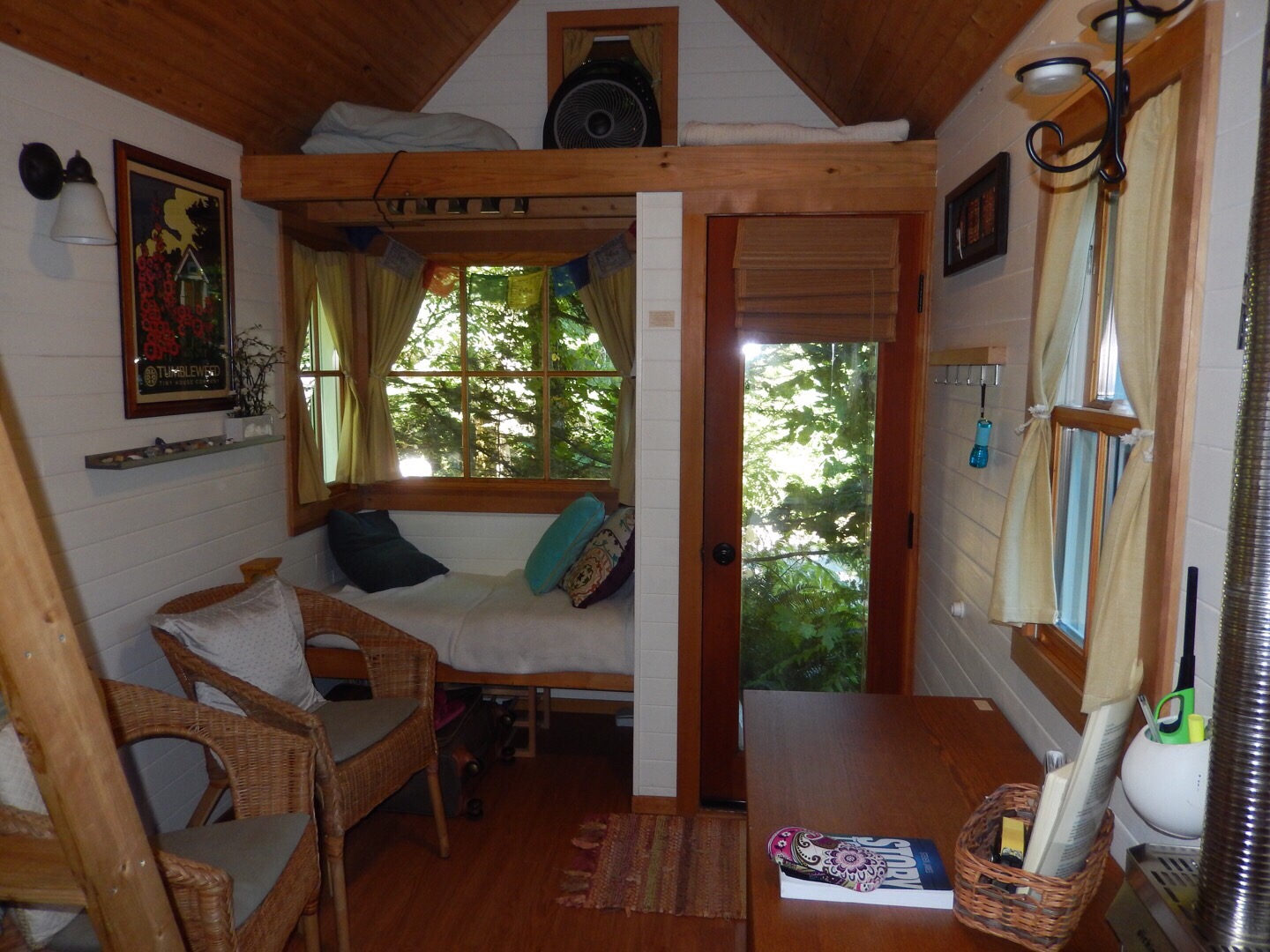
Tiny House
A Quiet & Cozy Tiny House

Do you own your stuff, or does your stuff own you? How much stuff does one person really need to be happy? These are questions I’ve been asking myself for several years now. I live in a 3,300 square foot house in suburban Dallas. Six months ago, I read Marie Kondo’s excellent book on organization, “The Life-Changing Magic of Tidying Up,” and started to eliminate the extraneous stuff, and there was a lot of it. My primary motivation was to not be embarrassed after my departure from this mortal plane about the amount of stuff I’d accumulated. I don’t want whichever relative gets stuck with the chore of disposing of it to shake their heads in disbelief. Plus I’d read with alarm E.L. Doctorow’s book “Homer & Langley,” about the hoarder brothers who were found dead beneath their piles of stuff. Plus my maternal grandmother was a bit of a hoarder. Best to nip any genetic predisposition in the bud.
Per Ms. Kondo’s instructions, I’d hold each item in my hands and ask myself, “does this inspire joy?” If the answer was “no,” then out it went. Ten jumbo lawn bags of stuff departed the house and made the journey to Goodwill or the trash bin. Now when I open my closets and drawers, I can actually see the stuff, AND it’s stuff I like!
So when I read the first article about the tiny house movement, and saw pictures, of course I was intrigued. Almost everyone I know is intrigued. How much space does a person really need to live and thrive? I don’t think I could reduce 57 years’ worth of possessions down to 400 square feet on a full-time basis, but the idea of spending August in a tiny house with a water view, somewhere in western Washington state, is immensely appealing.
Over the years, I’ve attempted to concoct a reason to be in Seattle or my hometown of Olympia in July or August, typically with no success. The summers in Dallas are scorchers, and there comes a time around the first part of August when even our wonderful, backyard swimming pool feels like a hot bath on a hot day.
This year, the excuse was to meet my sister-in-law in Seattle to help her with her genealogy project, then spend two days in Olympia to see my cousins. Eureka! Bridget and I had already figured out the Seattle hotel, but where would I stay in Olympia on my own? I’d tried most of the standard-fare hotels in the Olympia area, and I was really hankering to have a location on the water, preferably a B&B with kayaks available. When I got on AirB&B (for the first time!), I found the ideal spot: a darling tiny house with a partial water view, within walking distance of Tolmie State Park. The rate was about the same as what a standard hotel room would cost, and I’d get to try out a tiny house. No kayaks were mentioned in the description, but I probably wouldn’t have time for that anyway.
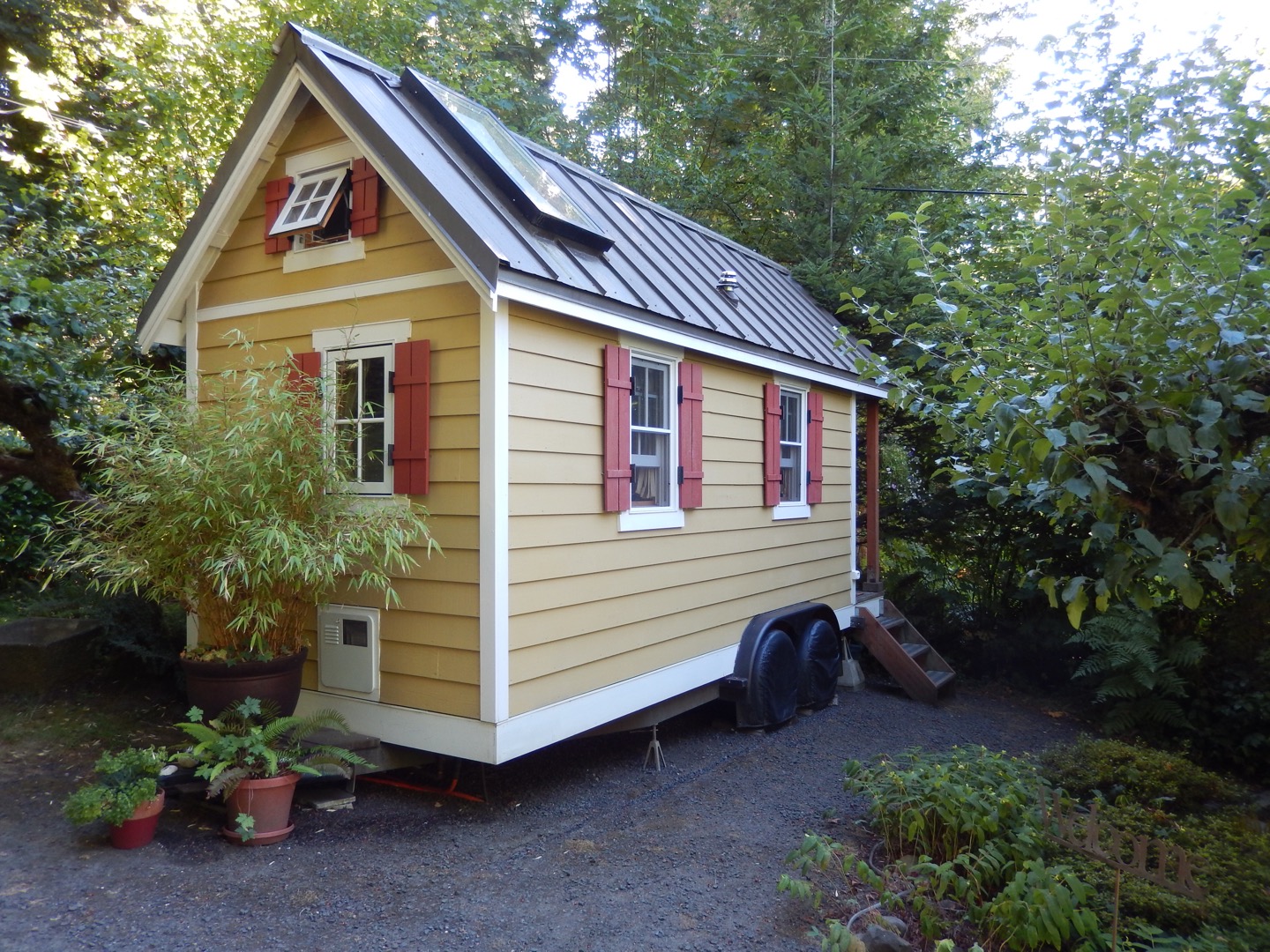
The Quiet & Cozy Tiny House, owned by Brittany Yunker, is five miles and four roundabouts from the Marvin Road exit off of Interstate 5. I left the roundabout-free Olympia area in 1989 and since then the roundabout idea has exploded. I’m proud that my fellow Washingtonians were concerned about the environment before the red-alert on climate change.

Inside the tiny house

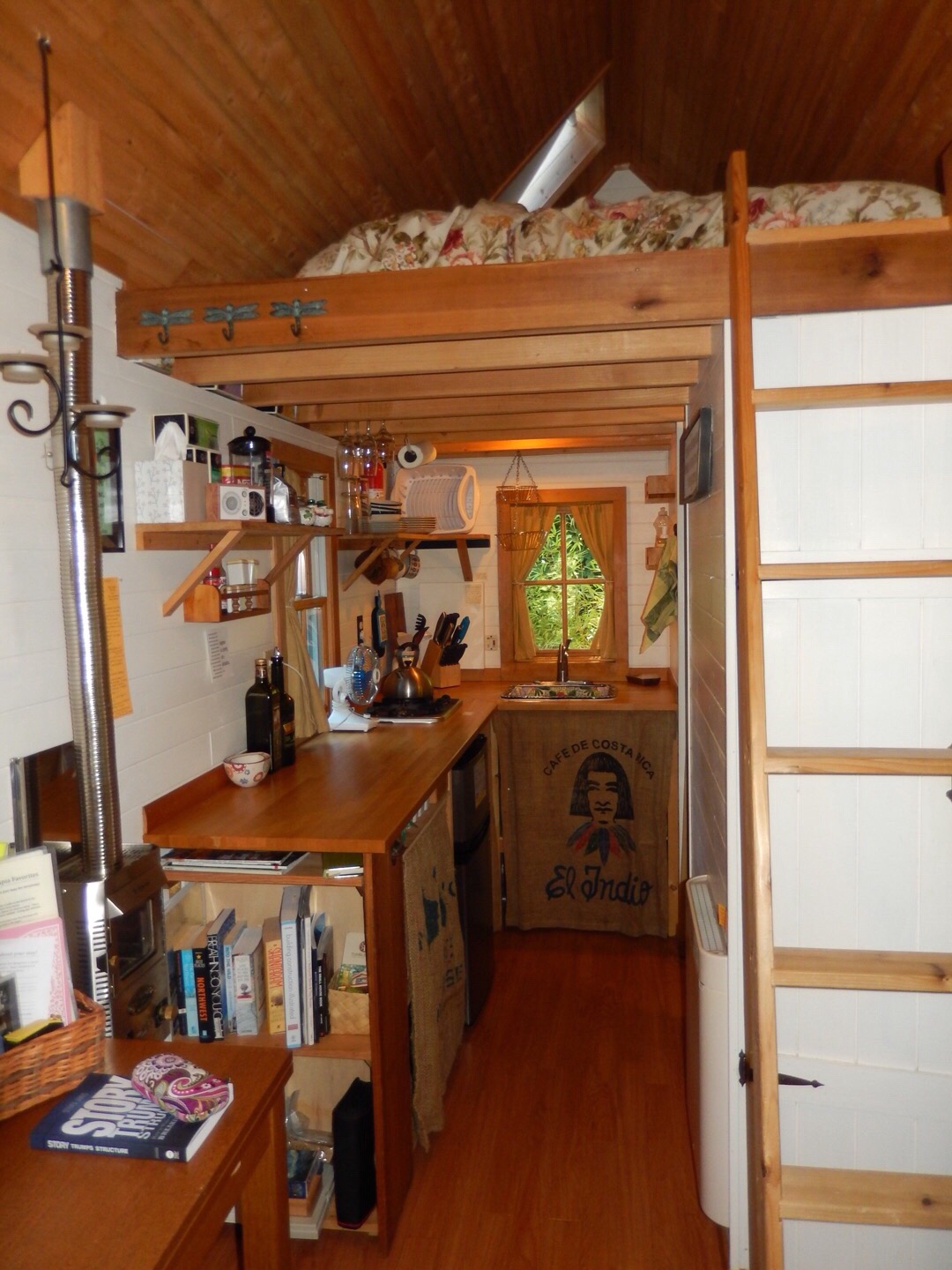
Brittany’s tiny house was exactly as described. It has a partial water view from the loft. Her parents live down the driveway and have a panoramic view of Nisqually Reach and Drayton Passage in the South Puget Sound from their front yard.

The South Puget Sound view from below the tiny house

Brittany encouraged me to use the fire pit, halfway up the driveway, and to feel free to sit in the chairs or the hammock on the lawn with the spectacular marine view.

I heaved my Texas-sized suitcase up the steps of the tiny house, removed my shoes (a house requirement), and settled in. I unpacked and put my clothes in the closet and food in the refrigerator. There were easy-to-follow instructions on the urine-diverting, composting toilet and I had no problems with it. AND it never smelled.

IMG_1134
View from the tiny house kitchen

I walked down the drive, crossed the lawn, and tried out the view location, which was spectacular. I went back to the house and ate the prepared dinner I’d purchased on the way in, although cooking in the kitchen would have been very easy, then I sat and read in the fire pit area at dusk.
Something rustled in the trees, and when I looked up from my book, a large raccoon was looking back at me from a nearby tree branch! We eyed each other suspiciously for several minutes before he disappeared.
The house was very quiet and I managed to climb up the ladder to the loft bed, open the shade of the skylight and look at the stars before falling into a deep sleep.
At 2 a.m., a light went on downstairs and I was immediately awake. Intruders? I trained my flashlight on the illuminated spot, put my glasses on, and then the light that was shining in the door went out. I listened and there was no sound. No one was jiggling the door, and the house seemed secure. Maybe the neighbors just got home and turned on their garage light.
In the morning I turned on the water-heater, made coffee, and walked the short distance to Tolmie State Park where I’d played in the tide pools as a child. It is still beautiful and conservation efforts have preserved the tide pools that teem with life.
The water was hot by the time I got back to shower. The shower-head has a “pause” button on it, similar to those on boats, and I wished I had one on my shower at home. Think of the water that gets wasted!

Tolmie State Park
Tolmie State Park

The rest of the day was spent seeing family and I didn’t return to the house until dusk. I was sorry I hadn’t arranged to stay there longer. When I walked up to the front door, the porch light turned on automatically. Ah ha! Mr. Raccoon must have been lurking and triggered the light the previous night. Mystery solved. Just call me Sherlock Holmes.
I would most definitely stay in Brittany’s tiny house again. The experience made me realize that 124 square feet is probably too small for more than a week, but I could be happy in a much smaller domicile than what I’ve got. I know that how much I have is too much, but just how much is enough?